
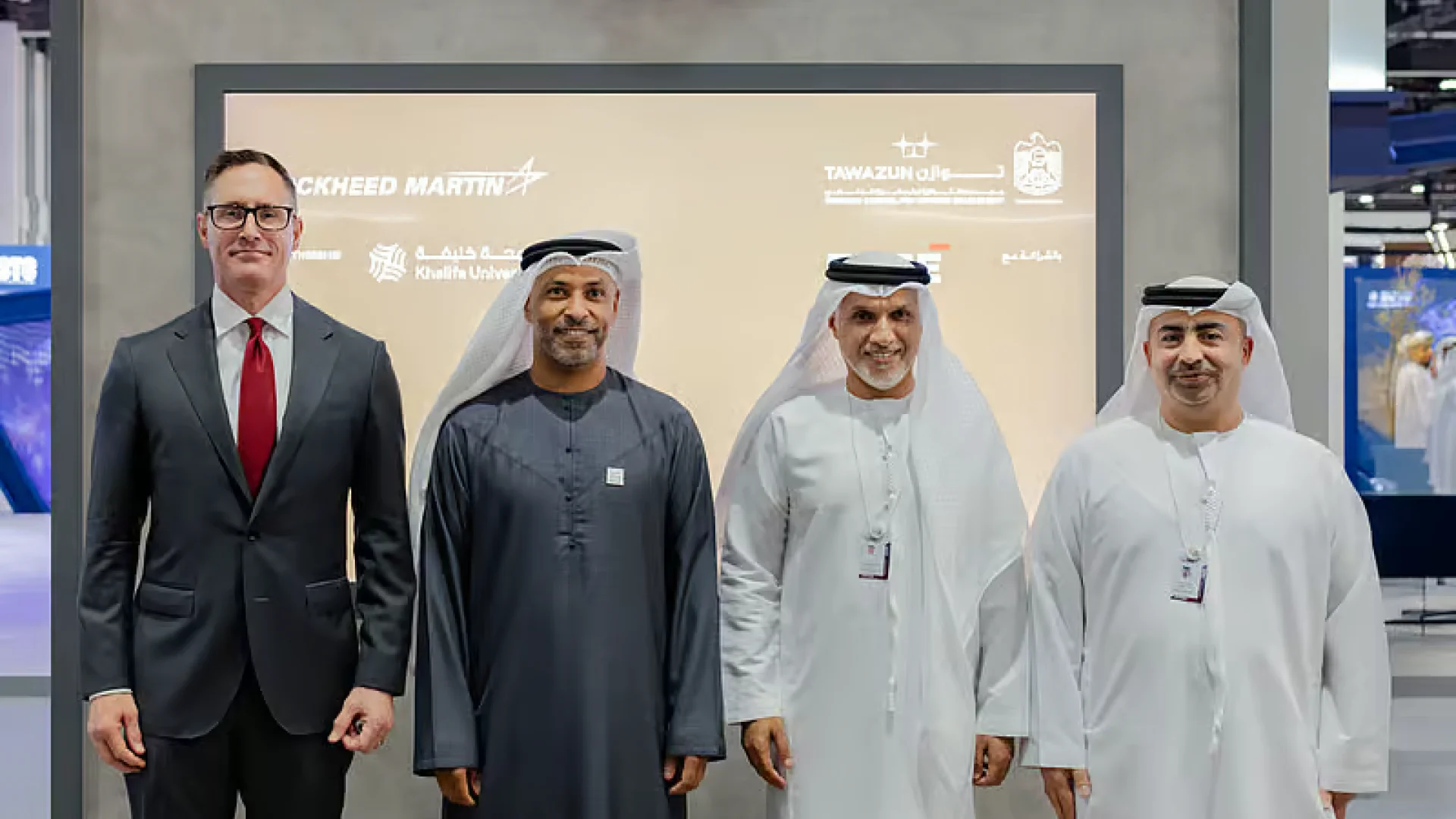

In the UAE’s next chapter of industrial ambition, the smallest components are suddenly the loudest: chips. A fresh agreement with Lockheed Martin puts semiconductor capability closer to the heart of the country’s defence-tech strategy, where secure supply chains, resilient electronics and sovereign know-how now matter as much as airframes and engines. It’s a move designed to accelerate local capacity, deepen partnerships and keep pace in a world where technology dominance is increasingly measured in nanometres and milliseconds.
The desert heat is still clinging to your shirt when the doors close and the temperature drops—clean, controlled, almost unnaturally calm. Inside, everything sounds softer. Footsteps. Voices. Even time, it seems, moves with caution.
Behind a pane of glass, screens glow in a tight row. A technician leans in. A cursor blinks. Somewhere in a rack, a fan spins up, then settles. It’s not dramatic. Not cinematic. And yet, you can feel it: the quiet intensity of a place where failure is not an option.
“Run it again,” someone murmurs. A short nod. A second attempt. The result lands—numbers aligning like a lock clicking open.
This is what the defence-tech race looks like in 2026. Less smoke and steel, more silicon and certainty.
The UAE has signalled a sharper acceleration in its global defence-technology push through a new agreement with Lockheed Martin, one of the world’s most influential defence companies. The focus: chip and semiconductor-related capability—an area that has become the strategic bottleneck of modern security systems.
On paper, it’s a partnership around technology. In reality, it’s a statement about leverage. Modern defence is no longer defined only by platforms—jets, ships, armoured vehicles—but by the electronics that make them see, decide and communicate. Chips sit at the centre of that nervous system: processing, sensing, secure links, radar performance, electronic warfare resilience, AI-enabled analytics. If you control the chips, you control the tempo.
A decade ago, semiconductors felt like a supply-chain topic for consumer electronics. Then the world watched factories go offline, logistics choke, export rules tighten, and geopolitical friction ripple through everything that depends on advanced components. Suddenly, the chip wasn’t just a part. It was a pressure point.
For countries building advanced defence capabilities, that pressure point is existential. Availability, trusted sourcing, verification, and the ability to maintain and upgrade systems over decades—these are not “nice-to-haves.” They are readiness.
The UAE’s decision to anchor a deal with Lockheed Martin around chips underscores a bigger intent: to reduce dependency risk while building the local expertise needed to participate higher up the value chain.
There’s a subtle shift happening in how the UAE positions itself. The old model—import the finished system, maintain it locally, upgrade when vendors allow—creates a ceiling. The new model aims for co-development, deeper industrial participation, and ecosystem-building. You can hear it in the language used around these initiatives: capability, partnership, acceleration, local value.
Semiconductor-related cooperation fits that model perfectly because it forces you to invest in the full supporting cast: test and measurement, quality assurance, specialised facilities, cybersecurity, skilled engineers, trusted logistics. A chip strategy is never just about chips. It’s about everything that must exist around them.
Big names and handshakes make headlines. But the real work lives in the paragraphs most people never read—the ones that define how collaboration actually happens. Agreements in this space typically revolve around several practical pillars:
Each pillar has a multiplier effect. Secure sourcing supports readiness. Training supports jobs. Standards support exportability. Local participation supports resilience—and a new generation of companies that learn by doing.
Talk to engineers in any advanced-tech sector today and you’ll hear the same refrain: “It’s all dual-use now.” The boundary between civilian and defence applications has thinned. A chip that makes edge AI more energy-efficient can transform medical imaging—and also enable faster on-board processing in unmanned systems. A secure communications module can serve critical infrastructure—and also hardened defence networks.
That’s why the UAE’s defence-tech push matters beyond defence. It can help attract adjacent industries: advanced manufacturing, aerospace services, cybersecurity firms, data infrastructure providers, materials science labs. Once a cluster begins to form, it rarely stays in one lane.
Follow the money in high technology and you eventually land on people. Specialists. The ones who can read a schematic like a story, who treat a tolerance threshold the way a musician treats pitch. These are the roles that reshape labour markets—slowly at first, then all at once.
A strengthened semiconductor and defence-tech agenda tends to lift demand for:
And where these people go, neighbourhoods respond. Commutes become a factor. School placements become a conversation over dinner. A new café opens where there used to be a quiet corner. The impact is not only industrial—it’s urban.
Imagine the moment after the signing. The photographers leave. The room relaxes by half a degree. Two project leads linger by a screen that still shows a block diagram—boxes, arrows, interfaces.
“If we can shorten validation,” one says, tapping the diagram with a pen, “we can bring iterations down from months to weeks.”
The other nods. “Then we need the lab capacity here. And the people. Otherwise it’s just paperwork.”
That’s the heart of it. Agreements matter. But what matters more is what gets built next.
For real estate investors, the UAE’s chip-focused defence-tech push is less about headlines and more about where demand will concentrate—and what kind of demand it will be. Semiconductor-adjacent and defence-tech activity tends to generate durable, high-quality tenants and a long runway of infrastructure investment.
1) Industrial and “high-spec” commercial space becomes more valuable. Defence-tech and semiconductor ecosystems require facilities that aren’t generic: secure offices, testing and calibration spaces, light industrial and assembly units, specialised storage, and often proximity to transport links. Investors should watch for growth around established and emerging technology/industrial zones, where absorption can accelerate as suppliers and subcontractors follow anchor partnerships.
2) Talent inflows support premium residential demand. High-skilled engineers and project managers typically arrive with stable incomes and relocation packages. That supports demand for quality apartments, villas in family-oriented communities, and serviced living for rotating teams. Areas with short commutes to employment hubs—and access to international schools and healthcare—tend to capture the highest, most resilient demand.
3) Data, power, and cooling infrastructure becomes a pricing driver. Chip-related R&D and modern defence systems are compute-heavy and security-sensitive. Real estate linked to reliable power supply, redundancy, and strong digital infrastructure (fibre connectivity, proximity to data centres) often commands a premium. Developers who embed resilient building systems and ESG-aligned efficiency (cooling optimisation, smart energy management) can position assets for longer leases and stronger covenant tenants.
4) Secondary urban uplift: hospitality, retail, education. Project ecosystems bring visiting specialists, training cycles, and international delegations. That supports business hotels, flexible office offerings, and mixed-use nodes with food, retail, and services. Education assets—particularly international schools—can benefit where talent clusters become permanent.
Investment thesis: The Lockheed Martin chip pact reinforces the UAE’s trajectory toward deeper advanced-industry clustering. A balanced strategy can pair core residential exposure in proven communities with selective positions in high-spec industrial/logistics and secure office assets near employment and infrastructure nodes. In this cycle, proximity to talent and technical infrastructure may matter more than proximity to landmark skylines.